
Frankfurt (Germany), 10 Aug. (LaPresse) – The water level of the Rhine continues to fall due to the drought and lack of rainfall, raising the risk that Germany’s main waterway may no longer be continuously navigable. The warning comes from the Bundesverband der Deutschen Binnenschifffahrt (Bdb), the German association for inland waterway transport. “Due to the lack of rainfall, a single-digit water level is forecast for the first time this week at the Kaub measuring point, which is important for shipping and the economy,” Bdb Director-General Jens Schwanen told the Rheinische Post. “In principle, the Rhine will therefore no longer be navigable throughout its length and will effectively be split in two,” he added. The water level at Kaub, between Koblenz and Mainz, is considered a benchmark for navigation on the Rhine. In this stretch, the riverbed is already relatively shallow and, according to the Bdb, the expected levels are a cause for particular concern. “With water levels this low, commercial shipping in the region will no longer be able to transport goods,” warned Schwanen. The same problem would also affect tourist boats and cruise ships. This would result in two separate navigation areas. To the north, traffic would continue between the ports of Amsterdam, Rotterdam and Antwerp and North Rhine-Westphalia, as far as the Cologne area, via the Rhine and the canal network of western Germany. Further south, however, traffic would continue on the Neckar, Moselle and Main rivers and on the Main-Danube Canal, a key international link to south-eastern Europe and the Black Sea.
Germany: drought alert, Rhine heading for record low levels
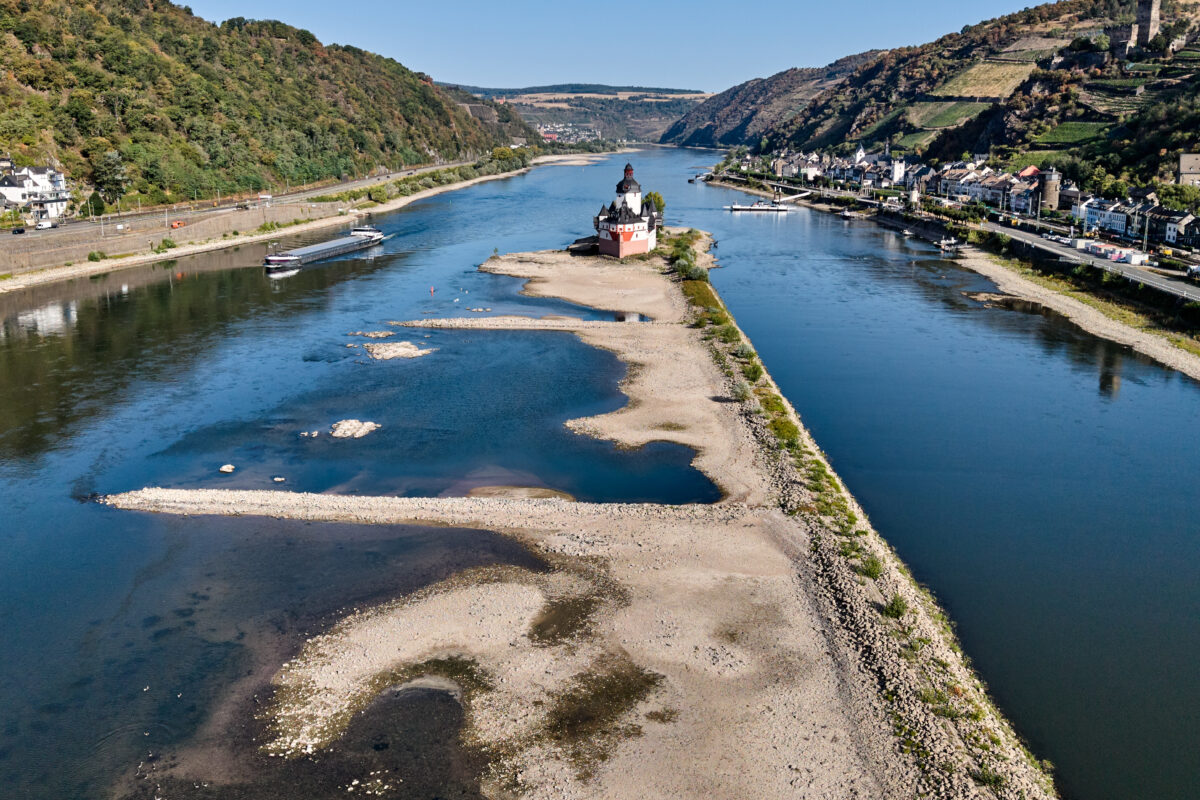

Frankfurt (Germany), 10 Aug. (LaPresse) – The water level of the Rhine continues to fall due to the drought and lack of rainfall, raising the risk that Germany’s main waterway may no longer be continuously navigable. The warning comes from the Bundesverband der Deutschen Binnenschifffahrt (Bdb), the German association for inland waterway transport. “Due to the lack of rainfall, a single-digit water level is forecast for the first time this week at the Kaub measuring point, which is important for shipping and the economy,” Bdb Director-General Jens Schwanen told the Rheinische Post. “In principle, the Rhine will therefore no longer be navigable throughout its length and will effectively be split in two,” he added. The water level at Kaub, between Koblenz and Mainz, is considered a benchmark for navigation on the Rhine. In this stretch, the riverbed is already relatively shallow and, according to the Bdb, the expected levels are a cause for particular concern. “With water levels this low, commercial shipping in the region will no longer be able to transport goods,” warned Schwanen. The same problem would also affect tourist boats and cruise ships. This would result in two separate navigation areas. To the north, traffic would continue between the ports of Amsterdam, Rotterdam and Antwerp and North Rhine-Westphalia, as far as the Cologne area, via the Rhine and the canal network of western Germany. Further south, however, traffic would continue on the Neckar, Moselle and Main rivers and on the Main-Danube Canal, a key international link to south-eastern Europe and the Black Sea.